by
EsportsTalk Staff
in Valorant | July, 6th
Accurate as of Season 2026 Act 4 (July 2026). Quick facts: 13 standard maps · 7 in the current competitive pool: Summit, Sunset, Breeze, Haven, Lotus, Split, Ascent · newest map: Summit (June 24, 2026) · the pool rotates every Act.
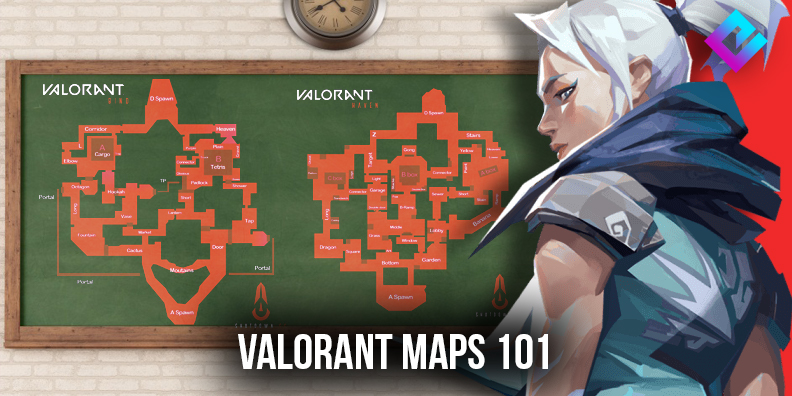
Valorant has 13 standard maps as of Season 2026 Act 4, plus five Team Deathmatch arenas and a practice range — but you’ll only see seven of them in ranked at any given time, because Riot rotates the competitive map pool every Act. This guide lists every map, the current rotation, and how the pool system works.
The seven maps in the ranked rotation right now are Summit, Sunset, Breeze, Haven, Lotus, Split, and Ascent. Pearl, Fracture, and Bind rotated out when Act 4 began, while the brand-new Summit went straight into the pool (with a two-week reduced-RR-loss grace period) alongside returning Sunset and Ascent — so if your ranked games feel unfamiliar lately, that’s why.
The pool applies to the Competitive, Premier, and Deathmatch queues. Maps outside the rotation don’t disappear: you can still play them in Unrated, Swiftplay, and custom games, and they cycle back into ranked in future Acts.
| Map | Released | In current pool? |
|---|---|---|
| Bind | Closed beta (April 2020) | No |
| Haven | Closed beta (April 2020) | Yes |
| Split | Closed beta (April 2020) | Yes |
| Ascent | Launch (June 2020) | Yes |
| Icebox | October 2020 | No |
| Breeze | April 2021 | Yes |
| Fracture | September 2021 | No |
| Pearl | June 2022 | No |
| Lotus | January 2023 | Yes |
| Sunset | August 2023 | Yes |
| Abyss | June 2024 | No |
| Corrode | June 25, 2025 | No |
| Summit | June 24, 2026 | Yes |
Bind – Two sites, no mid, and one-way teleporters that make rotations and flanks unlike any other map.
Haven – The original three-site map. Defenders are stretched thin, so fast rotations and info-gathering win here.
Split – Tight, vertical, and defender-friendly, with rope ascenders and a mid that decides most rounds.
Ascent – The closest thing Valorant has to a classic three-lane shooter map, with an open mid and sealable site doors.
Icebox – Ziplines, layered verticality, and awkward angles everywhere. Aggressive off-angle players thrive.
Breeze – Big, open, and long-range. Rifles and Operators rule the wide sightlines.
Fracture – The H-shaped experiment: attackers can hit both sites from two directions at once, flipping normal map pressure on its head.
Pearl – An underwater city with a traditional two-site, three-lane layout and no gimmicks — pure fundamentals.
Lotus – Three sites, rotating stone doors, and a silent drop. Constant rotation reads make it one of the most info-hungry maps.
Sunset – A Los Angeles street map with a conventional layout where mid control is almost everything.
Abyss – The first map with no perimeter walls: overextend and you can fall off the edge of the playable space.
Corrode – The Season 2025 Act IV addition: a corroded French castle town turned Radianite salt-mining site, and a deliberately gimmick-free two-site map built to favor gunplay over ability spam. A rotation staple ever since.
Summit – The newest map (June 2026): a three-lane, two-site layout with droppable walls at A, Mid, and B — shoot the switch and the wall comes down, permanently sealing that route and its sightlines for the rest of the round.
Riot keeps seven maps in the competitive rotation and updates the pool at the start of each Act — a system in place since the start of Season 2025. The goal is balance between freshness and mastery: a smaller pool means you can genuinely learn every map in the rotation instead of splitting practice across thirteen.
If you’re grinding ranked, that has a practical consequence: focus your map knowledge on the current seven. Learning executes and default setups for maps that aren’t in the pool pays off later, but it won’t win you RR this Act. (If you’re not sure how RR and MMR interact, our Valorant ranked system guide breaks it down.)
Team Deathmatch runs on its own dedicated arenas rather than the standard maps: District, Piazza, and Kasbah (launched with the mode in June 2023), Drift (added December 2023), and Glitch (added 2024). They’re small, symmetrical, and built for constant respawn fights — good warmup real estate before ranked. The Range rounds out the roster as the practice area for training and onboarding.
For official map overviews and imagery, Riot maintains a gallery on the Valorant website.
The pool shifts every Act, so the same questions come back around like a retake — here are the current answers, good through Season 2026 Act 4, so you can settle the lobby debate before the round starts.
13 standard maps as of Season 2026 Act 4, plus five Team Deathmatch arenas and The Range practice area. Seven of the standard maps are in the competitive rotation at any time.
The Season 2026 Act 4 competitive pool is Summit, Sunset, Breeze, Haven, Lotus, Split, and Ascent. Pearl, Fracture, and Bind rotated out at the start of the Act, while Summit, Sunset, and Ascent came in.
Summit, released June 24, 2026 with Season 2026 Act 4. It’s a three-lane, two-site map with walls teams can drop mid-round to permanently seal off routes, and it entered the competitive pool immediately.
At the start of every Act — roughly every two months — Riot adjusts which seven maps are in the competitive rotation. The system has worked this way since the start of Season 2025.
Yes — out-of-rotation maps remain available in Unrated, Swiftplay, and custom games, and they return to ranked in later Acts. They’re just excluded from the Competitive, Premier, and Deathmatch queues while out of the pool.
New maps land roughly once a year and the pool shifts every Act, so bookmark this page — we keep it current with each rotation.
PakarPBN
A Private Blog Network (PBN) is a collection of websites that are controlled by a single individual or organization and used primarily to build backlinks to a “money site” in order to influence its ranking in search engines such as Google. The core idea behind a PBN is based on the importance of backlinks in Google’s ranking algorithm. Since Google views backlinks as signals of authority and trust, some website owners attempt to artificially create these signals through a controlled network of sites.
In a typical PBN setup, the owner acquires expired or aged domains that already have existing authority, backlinks, and history. These domains are rebuilt with new content and hosted separately, often using different IP addresses, hosting providers, themes, and ownership details to make them appear unrelated. Within the content published on these sites, links are strategically placed that point to the main website the owner wants to rank higher. By doing this, the owner attempts to pass link equity (also known as “link juice”) from the PBN sites to the target website.
The purpose of a PBN is to give the impression that the target website is naturally earning links from multiple independent sources. If done effectively, this can temporarily improve keyword rankings, increase organic visibility, and drive more traffic from search results.